Contract and evidence
Employment contract, amendments, written statement of the essential terms of employment, agreements on salary and working hours.
Will the digital personnel file become mandatory in Germany in 2027? No – but from 1 January 2027 there is no longer any exemption from keeping payroll records electronically. Which documents are affected, which retention periods apply, what happens to paper originals and how to keep the personnel file properly in digital form.
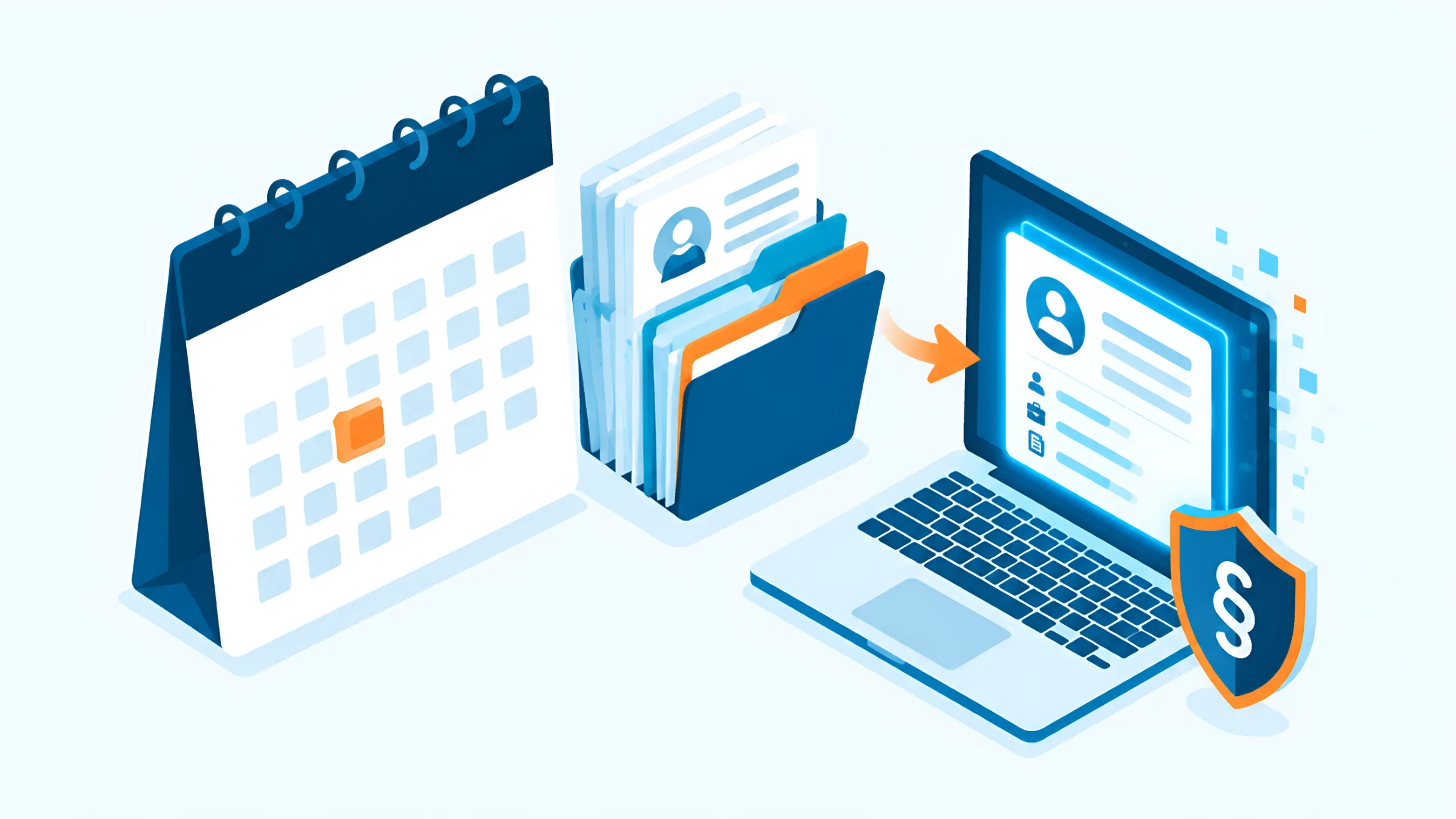
“From 2027, the digital personnel file is mandatory” – you are reading this sentence everywhere right now. In newsletters, at trade fairs, in offers from software vendors. But it is not true as it stands. Private employers in Germany have no obligation to keep a personnel file at all – neither on paper nor digitally.
What actually exists: since 1 January 2022, employers have had to keep certain payroll records electronically. If you did not want to do that, you could apply for an exemption. It is precisely this exemption that ends on 31 December 2026. From 2027, every employer must therefore keep part of its personnel documents in digital form – and many of these documents are in the personnel file today.
In this guide you will learn what German law really requires, which documents are affected, how long you have to keep personnel records, what happens to paper originals and what you need to watch out for regarding data protection and the works council. At the end, we show you how to introduce the digital personnel file in six steps.
As DOCSHERO®, we have been introducing digital files in companies of every size and industry for more than 20 years – including personnel files with a connection to DATEV.
Legal status and source review: 3 November 2026. Not legal advice.

DOCSHERO® / Personnel file check
Is your personnel file ready for 2027?
Enter your website and secure a no-obligation initial consultation. We take a look at your company in advance and show you how to keep payroll records and personnel files digitally in an audit-proof way.
We do not store your entry – the logo is loaded via Google.


Legal situation
In short: no. From 2027, all that ends is an exception that has existed since 2022.
There is no statutory obligation to keep a personnel file for private-sector companies in Germany. No law requires you to create a file for your employees, let alone that it has to be electronic. Almost every company keeps one anyway, because the employment contract, certificates and evidence have to be filed somewhere.
The public sector is different: under § 106 of the German Federal Civil Servants Act (Bundesbeamtengesetz, BBG), a personnel file must be kept for every federal civil servant. It may be kept partly or entirely in electronic form, but it does not have to be. Civil servants of the federal states are covered by their own state laws.
So where does the “mandatory from 2027” come from? From the Beitragsverfahrensverordnung (BVV, German Contribution Procedure Ordinance). It governs which payroll records employers have to keep for social security purposes. Since 1 January 2022, § 8 Abs. 2 BVV has required certain of these records to be added to the payroll records in electronic form. At the same time, § 8 Abs. 3 BVV allowed employers to be exempted from this until 31 December 2026 on application to the responsible audit service of the German Pension Insurance (Deutsche Rentenversicherung).
From 1 January 2027, electronic record-keeping therefore applies without exception. However, the obligation only covers payroll records – that is, part of what is in a typical personnel file. But if you have to keep these documents digitally anyway, you have a good reason to digitise the remaining documents at the same time.
Since 2022
certain payroll records have had to be kept electronically. On 31 December 2026, all that ends is the possibility of being exempted from this.
Basis: § 8 Abs. 2 and 3 Beitragsverfahrensverordnung (BVV)
Payroll records
The list is in § 8 Abs. 2 BVV. These are the documents most often affected in practice.
| Document | Concerns | § 8 Abs. 2 BVV |
|---|---|---|
| Proof of nationality and residence permit | Employees from non-EEA countries | Nr. 1 |
| Proof of exemption from insurance or release, e.g. certificate of enrolment | Working students and others | Nr. 1 |
| Documents on the nature and duration of a posting | Posted employees | Nr. 1 |
| Work permit from the Federal Employment Agency | Employees requiring approval | Nr. 2 |
| Data from social security notifications | all employees | Nr. 3 |
| Waiver of pension insurance exemption, exemption application with date of receipt | Mini-jobbers | Nr. 4, 4a, 4b |
| Copy of the written statement under the Nachweisgesetz | all employees | Nr. 6 |
| Declarations on other employment, proof of health insurance cover | Mini-jobbers, short-term employees | Nr. 7, 7a |
| Documents on status determination by the clearing office | Contractors, shareholders | Nr. 8 |
| Proof of parenthood and number of children | Long-term care insurance | Nr. 11 |
| Records under the Minimum Wage Act and the Posted Workers Act | affected industries and mini-jobbers | Nr. 13 |
| Declaration on care leave, certificate for care support allowance | Employees who are carers | Nr. 14, 15 |
| Data on A1 certificates for work abroad | Business trips and postings | Nr. 18 |
Extract from § 8 Abs. 2 BVV as amended from 1 July 2026. The full list comprises 20 numbers, two of which have been repealed. Not legal advice.
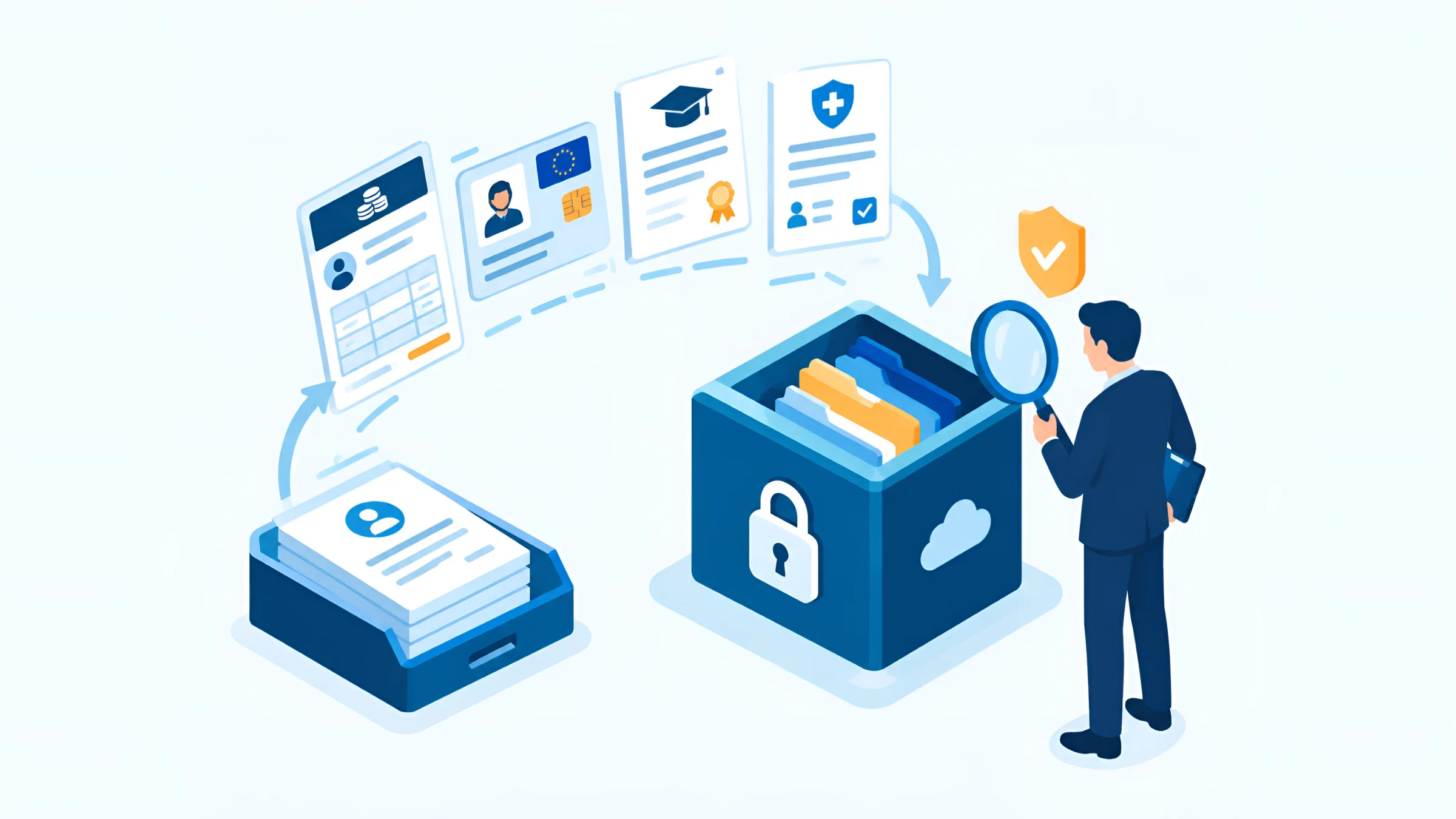
The list shows: it is mainly about evidence that matters for calculating contributions. When the German Pension Insurance audits you, it wants to see why someone was exempt from insurance, why a mini-jobber is not in the pension insurance scheme or why a childless supplement is missing. This evidence must be available electronically.
Much of the data is created digitally anyway, for example the notifications from payroll. The critical items are the paper documents that employees bring with them: certificates of enrolment, children’s birth certificates, residence permits or signed declarations from mini-jobbers. Under § 9 Abs. 5 BVV, they must be converted into an electronic format.
The electronic payroll records must be available at any time and readable without delay throughout the retention period. In theory, a folder of scans on the network drive is enough for this, but in practice it rarely is. By the next social security audit at the latest, you have to find the right documents for each person quickly – and completely. If you are scanning for this anyway, you can take the opportunity to digitise all your documents straight away and migrate your existing records cleanly.
One point is often overlooked: there is a second deadline for the audit itself. Under § 126 SGB IV, employers could also choose until the end of 2026 not to transmit the data for the electronically supported social security audit (euBP) digitally. This exception also expires on 31 December 2026.
Contents
Everything that concerns the employment relationship belongs in the personnel file – and only that.
Employment contract, amendments, written statement of the essential terms of employment, agreements on salary and working hours.
Cover letter, CV, references, proof of qualifications, residence permit and work permit.
Proof of exemption from insurance, mini-job declarations, parenthood, status determination, notifications.
Appraisals, target agreements, training, certificates and promotions.
Parental leave, care leave, special leave. Health data only where necessary, and protected separately.
Notice of termination or termination agreement, employment reference, employment certificate and final correspondence.
The German Federal Labour Court (Bundesarbeitsgericht, BAG) describes personnel files as a collection of documents and records that concern an employee’s personal and professional circumstances and have an inner connection with the employment relationship. Private notes, rumours or documents unrelated to work do not belong in it.
Particular care is needed with health data. Certificates of incapacity for work now mostly arrive electronically via the health insurance fund, and the employer is not entitled to know diagnoses. Documents on company integration management (betriebliches Eingliederungsmanagement) should be filed separately and with particularly tight access rights. Data protection for personnel files sets tight limits here: only what is necessary for the employment relationship is stored.
In a digital file, you no longer sort documents into tabs but by document type. Each document type gets its own access rights and its own retention period. That way, the manager sees the target agreement but not the garnishment order. And payroll finds the proof of parenthood without seeing the appraisals.
Periods
There is no period for the personnel file as a whole. What matters is the individual document.

| Document | Retention period | Legal basis |
|---|---|---|
| Payroll records for social security | until the end of the calendar year after the last social security audit | § 28f Abs. 1 SGB IV |
| Payroll account | until the end of the 6th calendar year after the last recorded wage payment | § 41 Abs. 1 EStG |
| Payslips and salary statements as accounting vouchers | 8 years | § 147 Abs. 1 Nr. 4, Abs. 3 AO |
| Records under the Minimum Wage Act | at least 2 years | § 17 Abs. 1 MiLoG |
| Records of working time beyond the daily working time | 2 years | § 16 Abs. 2 ArbZG |
| Application documents of rejected applicants | in practice up to 6 months | AGG deadlines, GDPR |
| Rest of the personnel file after leaving | no statutory period, usually 3 years | Standard limitation period § 195 BGB |
| Personnel file of federal civil servants | 5 years after closure | § 113 BBG |
The German Pension Insurance audits at least every four years (§ 28p SGB IV). If a document belongs to several categories, the longest period applies. After that, personal data must be deleted. Not legal advice.
The most important period for payroll records is laid down in the German Social Code (Sozialgesetzbuch): you must keep them until the end of the calendar year following the last social security audit. Because the pension insurance audits at least every four years, this often adds up to five years or more in practice. If a document is also used as an accounting voucher, the tax periods apply in addition. For accounting vouchers, annual financial statements and business letters, the retention periods under German tax and commercial law of six, eight or ten years apply.
For the rest of the file, the following applies after an employee leaves: keep it as long as claims are possible, then delete it. The standard limitation period is three years from the end of the year in which the claim arose. Most companies use this as their guide.
How long does a warning (Abmahnung) stay in the personnel file? There is no fixed period, even though two to three years are often quoted. According to the Federal Labour Court (judgment of 19 July 2012, 2 AZR 782/11), employees can only demand the removal of a justified warning once it has lost its warning function and the employer no longer has a legitimate interest in documenting it. That depends on the individual case. An unjustified warning, on the other hand, must be removed on request.
Originals
Not straight away. There is a clear rule for payroll records.
§ 9 Abs. 5 BVV is unambiguous here: the original documents must be kept until the social security audit has been finally concluded, or longer if other provisions require it. If you scan all paper documents in January 2027, you may therefore only destroy them after the next completed audit. After that, the electronic version is sufficient.
Some documents you should keep in the original as a matter of principle. Notice of termination and termination agreements require the written form under German law; the electronic form is excluded (§ 623 BGB). A fixed-term contract must also be agreed in writing (§ 14 Abs. 4 TzBfG). Digitally, this is only possible with a qualified electronic signature. Of the three types of electronic signature, only this one replaces the written form. If you want to have an employment contract signed digitally, you therefore need to know whether it contains a fixed term.
Since 1 January 2025, the written statement under the Nachweisgesetz has at least become easier: in many cases, the essential terms of employment may be transmitted electronically in text form. The document must be accessible and it must be possible to save and print it, and you must request a confirmation of receipt with the transmission. This simplification does not apply in industries covered by the German Act to Combat Undeclared Work (Schwarzarbeitsbekämpfungsgesetz), such as construction, hospitality or building cleaning.
For the scanned documents: complete, legible, unalterable. Define who scans, how quality is checked and where the files end up. These rules belong in a procedure description, similar to a GoBD process documentation for accounting.
DOCSHERO® / Digital personnel file
Scan paper files and still keep track?
Enter your website and find out in a short conversation how to migrate existing files, manage originals and keep track of deadlines automatically.
We do not store your entry – the logo is loaded via Google.
Data protection
Employees may view their file at any time. Everyone else only what they need for their job.

The right to inspect the personnel file is set out in § 83 of the German Works Constitution Act (Betriebsverfassungsgesetz, BetrVG): employees may view their file without giving a reason and may bring in a member of the works council. Their own statements on its content must be added to the file on request. In addition, Art. 15 GDPR grants a right of access and to a copy of the stored data.
Within the company, the principle is as much as necessary, as little as possible. HR sees the whole file, the manager only what they need for their management tasks, and payroll the documents relevant to payroll. On paper, this can hardly be implemented: whoever unlocks the cabinet sees everything. Digitally, you control access rights per role and document type, and every access is logged.
Since the judgment of the CJEU of 30 March 2023 (C-34/21), according to the case law of the German Federal Labour Court (BAG), the legal basis for processing is no longer the general clause in § 26 Abs. 1 Satz 1 BDSG, but as a rule directly Art. 6(1) GDPR, and additionally Art. 9 GDPR for health data. In practice, this means: every processing operation needs a clear purpose, an authorisation concept and a deletion concept.
If the data is held by a service provider, you need a data processing agreement. With a cloud solution, it pays to look at the location: our HEROcloud runs on its own infrastructure in German and European data centres.
Co-determination
Yes, if there is one. And before the software goes live.
Under § 87 Abs. 1 Nr. 6 BetrVG, software that is objectively suitable for monitoring the behaviour or performance of employees is subject to co-determination. Whether you intend to do so is irrelevant. A digital personnel file with access logs and reports generally falls under this.
The usual approach is a works agreement (Betriebsvereinbarung). It governs which data goes into the file, who accesses what, how access may be logged and analysed and when data is deleted. If no agreement is reached, the conciliation committee (Einigungsstelle) decides.
So involve the works council from the start, not just shortly before launch. If you can already present the access rights concept in the first workshop, you save yourself rounds of revisions later. Incidentally, the works council does not have a permanent right to inspect all files. A works council member only sees a file if the employee brings them in. Otherwise, the works council only receives, case by case, the information it needs for a specific task.
Weighing up
The obligation only concerns part of the file. Is the rest still worth it?
Audit-proof: Payroll records are complete and immediately readable when the pension insurance carries out its audit.
Found faster: Full-text search instead of a filing cabinet – even when working from home or across several locations.
Clear access rights: Each role sees only what it needs. Every access is logged.
Deadlines automated: Probationary periods, fixed terms, retention and deletion no longer run via Excel and calendars.
Less duplicate entry: Master data comes from payroll instead of being maintained twice.
Less space: No more archive room for binders that nobody touches any more.
There are also disadvantages, and you should know them before you start:
Most of these points are one-offs. The advantages, on the other hand, take effect every day, and you have to meet the obligation for payroll records from 2027 anyway. If you only scan the mandatory documents, you end up with two filing systems: a digital one for the audit and a paper one for everything else. That is usually more expensive than a single digital file.
Implementation
With a clear plan, the file is ready to go in a few weeks – in good time before the next audit.
Clarify which documents exist today, where they are kept and which of them fall under § 8 Abs. 2 BVV.
Define access rights, retention period and deletion rule for each document type – ideally together with your data protection officer and tax adviser.
Present the access rights and logging concept early and conclude a works agreement.
Set up the file and connect it to payroll, for example DATEV, so that master data flows automatically.
Scan paper files in a structured way, check the quality and keep the originals until the next social security audit.
From now on, onboarding, contract changes, certificates and inspection requests run directly via the digital file.
In ELO, the digital personnel file is called ELO HR Personnel File. It brings together all of an employee’s documents in one file, with access rights per role, automatic deadlines for probationary periods, fixed terms and retention, onboarding and self-service. If you run payroll with DATEV, you connect the file to DATEV LODAS or DATEV Lohn und Gehalt via ELO Personnel File for DATEV. Master data is then synchronised in both directions. This is based on the ELO for DATEV partnership: ELO is an official DATEV partner.
New documents reach the right file via a digital mailroom, and employees sign contracts digitally with HEROsign. Because the personnel file runs on the same platform as invoices, contracts and emails, you only need one audit-proof archive for all documents. That is exactly what distinguishes a platform like ELO from a simple DMS that only stores files.
DOCSHERO® is a certified ELO Business Partner and sets up the digital personnel file so that access rights, deadlines and processes fit your HR – on your servers or in the HEROcloud. The free digitalisation check shows you in just a few minutes where your company stands today.
GOOD TO KNOW
No. Private employers in Germany do not have to keep a personnel file at all. From 1 January 2027, all that ends is the possibility of being exempted from keeping certain payroll records electronically under § 8 Abs. 2 BVV. This obligation itself has applied since 2022.
The payroll records listed in § 8 Abs. 2 BVV, for example proof of exemption from insurance, residence permits, mini-job declarations, the copy of the written statement under the Nachweisgesetz, proof of parenthood and records under the Minimum Wage Act.
Everything that has an inner connection with the employment relationship: application, contract and amendments, evidence, certificates, appraisals, warnings, documents on absences and on leaving. Private information unrelated to work does not belong in it.
Above all one-off effort: concept, setup, scanning existing files, training and the works agreement. On top of that come ongoing costs and dependence on the vendor. Paper originals are still needed for the time being.
No. You decide for yourself which software you use. The only obligation is to keep payroll records electronically. If you run payroll with DATEV, you can, for example, keep the personnel file in ELO and connect it to LODAS or Lohn und Gehalt with ELO Personnel File for DATEV.
Yes. § 8 BVV applies to all employers, regardless of size. The obligation to keep payroll records under § 28f Abs. 1 SGB IV does not apply to people employed in private households.
An exemption from the audit service of the German Pension Insurance is only possible until 31 December 2026. From 2027, there is no longer any exception.
Originals of payroll records only after the next social security audit has been finally concluded (§ 9 Abs. 5 BVV). You should keep notices of termination, termination agreements and fixed-term agreements permanently in the original because of the written form requirement.
There is no uniform period. Payroll records until the end of the year after the last social security audit, the payroll account until the end of the sixth year after the last wage payment, the rest of the file usually three years after the employee leaves.
There is no fixed period. According to the BAG, a justified warning only has to be removed once it has lost its warning function and the employer no longer has a legitimate interest in documenting it. The frequently quoted two to three years are only a rule of thumb.
Employees may view their own file (§ 83 BetrVG), in practice without giving a reason, with a member of the works council if they wish. Within the company, only people who need the data for their tasks.
Yes, if there is a works council. A digital personnel file is generally objectively suitable for monitoring behaviour or performance and is therefore subject to co-determination under § 87 Abs. 1 Nr. 6 BetrVG.
If the auditor cannot determine the contributions for each individual because documents are missing, they may set them on the basis of the total payroll under § 28f Abs. 2 SGB IV. This often leads to back payments.
Legal status and source review: 3 November 2026. Statutory requirements are linked directly. This article is not legal advice – in individual cases, please involve a lawyer, tax adviser or data protection officer.