
Keep the original format
Documents received electronically stay electronic. For e-invoices, the XML file is the original, not the printout.
German retention periods for 2026 and 2027 at a glance: a table for companies, personnel files and private individuals, the new 8-year period for invoices, how to calculate deadlines, what you may destroy from 1 January 2027 and how to meet retention periods digitally.
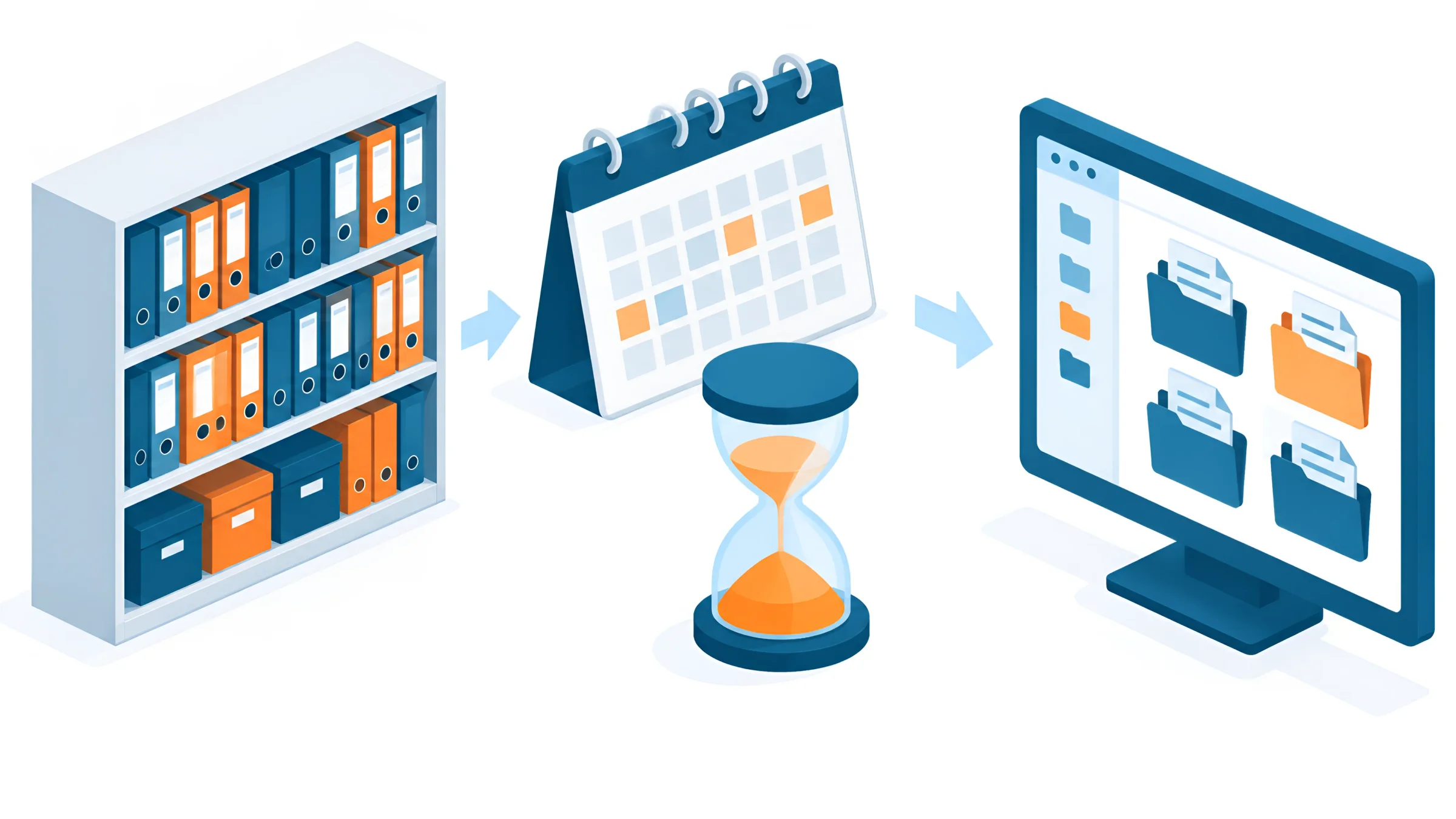
Every January, the same question: which binders can go into the shredder now? If you destroy records too early, you risk trouble with the German tax office. If you keep them too long, you pay for archive space – and with personal data you may even be breaching the GDPR.
On top of that, new rules have applied since 2025. You now only have to keep invoices and other accounting vouchers for eight instead of ten years. And if you receive e-invoices, you must archive them in their original format. In this guide you will find all the key German retention periods in one table – for companies, personnel files and private individuals. Plus: how to calculate the period correctly, which records you may destroy from 1 January 2027, which exceptions apply and how to meet retention periods digitally and automatically.
As DOCSHERO®, we have been setting up archives for companies of every size and industry – from small businesses to large groups – for more than 20 years that monitor retention and deletion periods on their own.
Legal status and source review: 29 October 2026.

DOCSHERO® / Archive check
Does your archive already meet retention periods on its own?
Enter your website and secure a no-obligation initial consultation. We take a look at your company in advance and show you how an audit-proof archive monitors retention and deletion periods automatically.
We do not store your entry – the logo is loaded via Google.


Basics
Retention periods define how long companies must keep records – so that the tax office and auditors can trace at any time what happened.
In Germany, the statutory retention periods for companies are laid down mainly in two laws: in § 147 of the German Fiscal Code (Abgabenordnung, AO) for tax law and in § 257 of the German Commercial Code (Handelsgesetzbuch, HGB) for commercial law. On top of that come special provisions, for example in the German VAT Act (UStG) for invoices, in the Income Tax Act (EStG) for payroll accounts or in the Working Hours Act (ArbZG) for working time records.
The retention obligation applies to everyone who is required to keep books or records for tax purposes: merchants, corporations, traders above certain turnover and profit thresholds, but also freelancers for their records and vouchers. Even if you only prepare a cash-basis income statement (Einnahmen-Überschuss-Rechnung), you must keep invoices and vouchers.
How records are kept is governed by the GoBD – the German principles for the proper keeping and retention of books, records and documents in electronic form. What the GoBD principles require in detail mainly concerns digital documents: they must be complete, unalterable, retrievable and machine-readable for the tax audit.
8 instead of 10 years
is all you now have to keep invoices, bank statements and other accounting vouchers since 1 January 2025. The reduction applies to all vouchers whose old period had not yet expired at the end of 2024.
Basis: Bürokratieentlastungsgesetz IV, § 147 Abs. 3 AO, § 257 Abs. 4 HGB, § 14b UStG
Table
The most important periods under German tax and commercial law at a glance.
| Record | Period | Legal basis |
|---|---|---|
| Commercial books, ledgers, general ledger, journals | 10 years | § 147 Abs. 1 Nr. 1 AO, § 257 HGB |
| Annual financial statements, balance sheets, profit and loss statements | 10 years | § 147 Abs. 1 Nr. 1 AO, § 257 HGB |
| Opening balance sheets, inventories, management reports | 10 years | § 147 Abs. 1 Nr. 1 AO, § 257 HGB |
| Cash books | 10 years | § 147 Abs. 1 Nr. 1 AO |
| Work instructions, organisational documents, process documentation | 10 years | § 147 Abs. 1 Nr. 1 AO |
| Incoming and outgoing invoices | 8 years | § 147 Abs. 1 Nr. 4 AO, § 14b UStG |
| E-invoices (XRechnung, ZUGFeRD) in their original format | 8 years | § 14b UStG, GoBD |
| Bank statements (business) | 8 years | § 147 Abs. 1 Nr. 4 AO |
| Cash vouchers, receipts, cash reports | 8 years | § 147 Abs. 1 Nr. 4 AO |
| Credit notes, travel expense and entertainment receipts | 8 years | § 147 Abs. 1 Nr. 4 AO |
| Payslips and salary statements (as accounting vouchers) | 8 years | § 147 Abs. 1 Nr. 4 AO |
| Delivery notes, if they serve as accounting vouchers | 8 years | § 147 Abs. 1 Nr. 4 AO |
| Delivery notes that are not accounting vouchers | until the invoice is received or sent | § 147 Abs. 3 AO |
| Commercial and business letters received | 6 years | § 147 Abs. 1 Nr. 2 AO, § 257 HGB |
| Copies of commercial and business letters sent | 6 years | § 147 Abs. 1 Nr. 3 AO, § 257 HGB |
| Business emails with the character of a commercial letter | 6 years | § 147 AO, § 257 HGB |
| Quotes and order confirmations that led to a transaction | 6 years | § 147 Abs. 1 Nr. 2, 3 AO |
| Contracts (e.g. rental, leasing, maintenance contracts) | 6 years from the end of the contract | § 147 Abs. 1 Nr. 5 AO |
| Payroll accounts | until the end of the 6th year after the last entry | § 41 Abs. 1 EStG |
| Other tax-relevant records | 6 years | § 147 Abs. 1 Nr. 5 AO |
| Data carriers with legacy data after a system change | 5 years | § 147 Abs. 6 AO |
Each period begins at the end of the calendar year in which the record was created. If a contract or voucher is also an accounting voucher, the longer period applies. This is not legal or tax advice – involve your tax adviser in individual cases.
A rule of thumb helps with sorting: everything that concerns the books themselves, 10 years. Everything that supports a booking, 8 years. Everything that is just correspondence, 6 years. If in doubt, the longer period applies.
Two points are often overlooked in practice. First: the process documentation (Verfahrensdokumentation) is also one of the organisational documents and must be kept for ten years. It describes how vouchers are captured, checked and archived at your company. An up-to-date GoBD process documentation is therefore an archive item in its own right. Second: if you change your accounting or archive system, you must keep the legacy data machine-readable. When you move to a new system, HEROmigration ensures that documents are preserved together with their metadata and links.
Calculation
The period does not start on the date on the document, but at the end of the year. Here is how to calculate it correctly.
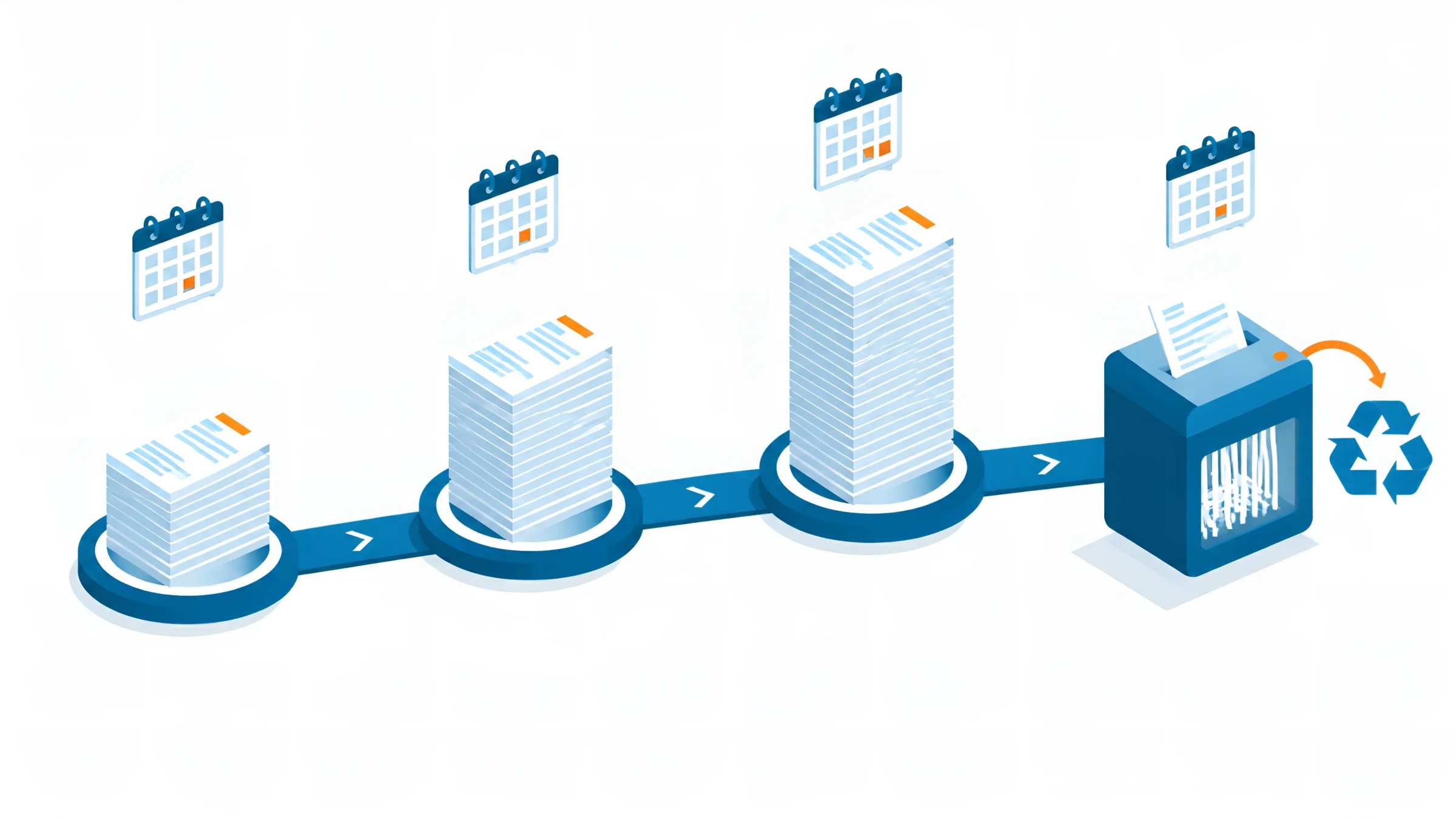
What counts is the calendar year in which the voucher was created, the letter was received or sent, or the last entry was made in the book.
The period begins at the end of that calendar year, i.e. on 31 December.
Add 6, 8 or 10 years to the start of the period – depending on the type of record.
Is a tax audit still ongoing, is an objection pending or is a tax assessment provisional? Then you may not destroy the records yet.
Only destroy records after the period has ended, and record which documents were destroyed or deleted, when and how.
An example: an incoming invoice dated 15 March 2018 is an accounting voucher. The period begins on 31 December 2018 and lasts eight years. It therefore ends on 31 December 2026. From 1 January 2027, you may destroy the invoice – unless an exception applies.
For books, the last entry is what counts. If the last bookings for the 2016 financial year were only made in 2017, the ten-year period only begins at the end of 2017. For the annual financial statements, the year in which they were prepared is what counts. Especially with statements that are finished late in the following year, it pays to look closely.
Destroying
Unless an exception applies, these records may leave the archive at the turn of the year.
Books, annual financial statements, inventories: with the last entry or preparation in 2016 or earlier.
Invoices and other accounting vouchers: created in 2018 or earlier.
Bank statements and cash vouchers: from 2018 or earlier.
Commercial and business letters: received or sent in 2020 or earlier.
Payroll accounts: with the last entry in 2020 or earlier.
Other tax-relevant records: from 2020 or earlier.
Watch out for records that could already have been destroyed before 2025: the reduction to eight years applies to all accounting vouchers whose period had not yet expired on 1 January 2025. That is why the vouchers from 2015 and 2016 could be destroyed in one go on 1 January 2025, and those from 2017 on 1 January 2026.
If you archive your vouchers digitally, you do not have to sort binders every year. An archive system knows the document type and creation date of every document – and therefore when its period ends. At the turn of the year, it automatically shows you what may be deleted – and locks everything that is still needed because of an ongoing audit.
Personnel
There is no uniform period for the personnel file. It depends on the individual documents.
| Record | Period | Legal basis |
|---|---|---|
| Personnel file in general (after leaving) | usually 3 years | Standard limitation period § 195 BGB |
| Payslips and salary statements | 8 years | § 147 Abs. 1 Nr. 4 AO |
| Payroll accounts | until the end of the 6th year after the last entry | § 41 Abs. 1 EStG |
| Working time records for overtime | 2 years | § 16 Abs. 2 ArbZG |
| Application documents of rejected applicants | approx. 6 months | AGG deadlines, GDPR |
| Documents on company pension schemes | until the end of the benefit obligation | BetrAVG |
Individual documents in a personnel file may be subject to longer retention, for example if they are also accounting vouchers. Once all periods have expired, personal data must be deleted.
With personnel files, two obligations collide: German labour, tax and social security law require certain records to be kept. The GDPR (DSGVO) requires personal data to be deleted as soon as it is no longer needed. That is why you should not look at the personnel file as a whole, but set a period per document type.
A digital personnel file makes exactly that possible. Every document gets a document type when it is filed – and with it, its retention period. After an employee leaves, the right period runs for each record – and the system reminds you of the deletion in good time. This is particularly important for application documents: after the procedure is completed, they should only remain stored for as long as possible claims under the German General Equal Treatment Act (AGG) can be asserted.
Which data belongs in the file at all is governed by data protection for personnel files: only what is necessary for the employment relationship. There is no legal obligation to keep a digital personnel file. Since 2025, however, employers may in many cases document the essential terms of employment in text form – which makes the digital file even easier.
DOCSHERO® / Digital retention
Never count binders again at the turn of the year?
Enter your website and find out in a short conversation how to map retention periods and deletion obligations automatically in your archive.
We do not store your entry – the logo is loaded via Google.
Digital
The periods are the same for paper and digital documents. But the requirements for how they are kept are stricter for digital ones.
Documents received electronically stay electronic. For e-invoices, the XML file is the original, not the printout.
Once filed, documents must not be changed or deleted unnoticed. Every change must be traceable.
In an audit, records must be presented within a reasonable time – even after years.
The tax office has a right to data access. Data must be able to be handed over in an analysable format.
Business emails with the character of a commercial letter must be kept for six years; attached invoices, as accounting vouchers, for eight years.
Paper may be destroyed after substitute scanning if the scan, archiving and procedure comply with the GoBD.
A network drive or an email inbox does not usually meet these requirements. Files can be changed, moved or deleted there unnoticed, and an evaluation for the tax audit is hardly possible. What audit-proof means and how audit-proof archiving is implemented technically is therefore at the heart of all digital retention.
Whether an email has to be kept depends on its content. The email archiving obligation applies to all emails with the character of a commercial letter, i.e. quotes, orders, order confirmations or complaints. That is why there are dedicated solutions for emails: email archiving stores business emails automatically, completely and unalterably. For e-invoices, archiving should happen directly in incoming invoice processing – regardless of whether XRechnung or ZUGFeRD arrives. If you want to receive e-invoices, file the XML original in an audit-proof way straight away and link it to the booking. Since the mandatory e-invoicing in Germany came in, this has been part of the required programme. And if you still have paper in-house, you can maintain the retention periods as you digitise documents.
Data protection
Keeping and deleting are two sides of the same coin.
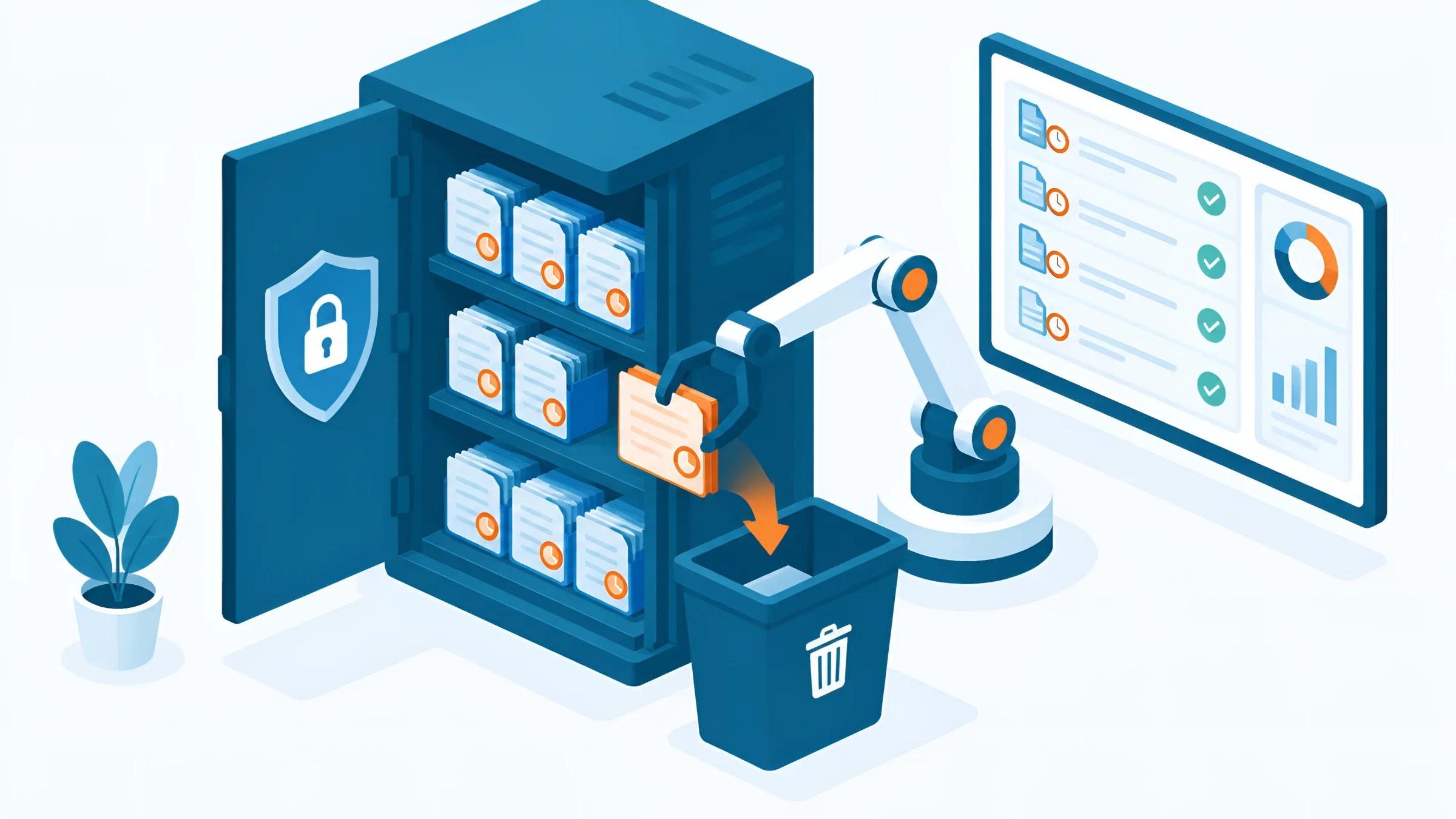
The GDPR requires personal data to be deleted as soon as the purpose of processing no longer applies. A statutory retention obligation, however, is a legitimate reason to store data for longer (Art. 17 Abs. 3 DSGVO). In other words: during the period, you may and must keep the data. After the period, you usually have to delete it.
In practice, this means three things:
Without a system, this is hardly manageable. A document management system stores periods per document type, locks expired data and deletes it after approval. That way, you meet your retention and deletion obligations in the same process.
Risks
Missing records can become expensive – even if everything was booked correctly.
If you destroy records too early or do not keep them properly, you risk several consequences:
Conversely, keeping records for too long is not risk-free either. Besides the cost of archive space, you risk breaching the GDPR with personal data if there is no longer any reason to store it.
Private
For most private records there is no legal obligation – but good reasons to keep them.
| Record | Recommendation / period | Basis |
|---|---|---|
| Tradesmen’s invoices for work on your house and property | 2 years (mandatory) | § 14b Abs. 1 UStG |
| Records for high surplus income (over €500,000, from 2027 over €750,000) | 6 years (mandatory) | § 147a AO |
| Tax assessments and receipts for the tax return | at least until they become final | Recommendation |
| Purchase receipts and warranty documents | until the end of the statutory warranty or guarantee | § 438 BGB |
| Bank statements (private) | recommended at least 3 years | Standard limitation period § 195 BGB |
| Judgments, enforcement orders, enforceable titles | 30 years | § 197 BGB |
| Certificates, deeds, pension and insurance records | permanently | Own interest |
You should keep private records for which there is no obligation at least as long as claims can become time-barred. For pension records, permanent retention is worthwhile.
For private individuals in Germany: most periods are recommendations, not obligations. A real obligation exists mainly for tradesmen’s invoices and for people with very high income from letting, capital assets or similar sources. For them, the threshold rises from 2027 from 500,000 to 750,000 euros a year.
If you digitise private records, you should still keep the originals of deeds, certificates and notarial documents. The rest can be scanned and stored securely.
Implementation
With a well-designed archive, you will never have to count binders again.
Assign every record to a document type: invoice, contract, business letter, personnel document and so on.
Assign each document type its retention period and the start of its period – ideally together with your tax adviser.
Store all documents unalterably, completely and with metadata in an archive system.
Flag records that have to be kept longer because of audits or proceedings.
Have the system generate a deletion list when the period ends, approve it and document the deletion.
That is exactly how a good archive works. With ELO document management, every document gets its period when it is filed. Whether contract management, incoming invoices via e-invoicing software or personnel files: all records flow through a digital mailroom into the same audit-proof archive. Periods, locks and deletions are documented and traceable for the tax audit.
DOCSHERO® sets up such archives to fit your company – on your servers or in our HEROcloud from German data centres. The free digitalisation check shows you in just a few minutes where your company stands today.
GOOD TO KNOW
Books, annual financial statements, inventories and organisational documents 10 years, accounting vouchers such as invoices and bank statements 8 years, commercial and business letters and other tax-relevant records 6 years.
10 years apply to commercial books, annual financial statements, opening balance sheets, inventories, management reports and work instructions. 6 years apply to commercial and business letters received and sent and other tax-relevant records. Since 2025, invoices and other accounting vouchers sit in between: 8 years.
Since 1 January 2025, eight years. The period begins at the end of the year in which the invoice was issued or received. E-invoices must be kept in their original electronic format.
Unless an exception applies: books and annual financial statements with the last entry in 2016 or earlier, accounting vouchers from 2018 or earlier, and business letters and other records from 2020 or earlier.
At the end of the calendar year in which the record was created, the letter was received or sent, or the last entry was made in the book.
Yes. The periods are the same. Electronic documents, however, must be kept electronically, unalterably, completely, retrievably and machine-readably. A printout does not replace the digital original.
There is no uniform period. As a rule, the personnel file is kept for three years after the employee leaves. Payroll records, payroll accounts and working time records have their own periods of between two and eight years.
Business bank statements are accounting vouchers and must be kept for eight years. There is no legal obligation for private bank statements; at least three years is recommended.
For companies, there is no 30-year obligation under German tax and commercial law. It is worth keeping enforceable titles such as judgments or enforcement orders for 30 years, however, because claims established by them become time-barred after 30 years.
The tax office can estimate the tax bases, disallow the input VAT deduction and impose fines. In the event of insolvency, breaching the retention obligation can be a criminal offence.
Yes, most vouchers, if you scan them in a GoBD-compliant way, archive them in an audit-proof way and document the procedure. Exceptions include annual financial statements, opening balance sheets and certain customs documents.
Legal status and source review: 29 October 2026. Statutory requirements are linked directly. This article is not legal or tax advice – please check periods in individual cases with your tax adviser.